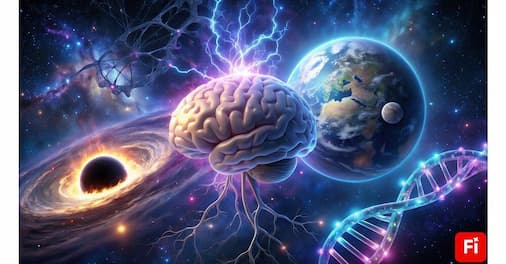
The 100 Greatest Scientific Mysteries Science Still Can’t Explain
Human curiosity has driven some of the greatest discoveries in history. From landing on the Moon to decoding the human genome, science has transformed our understanding of the universe. Yet despite these incredible achievements, countless scientific mysteries remain unsolved.
Every year, researchers uncover new evidence that answers old questions while raising entirely new ones. Why does most of the universe appear to be invisible? What exactly is consciousness? How did life begin on Earth? Could intelligent life exist elsewhere in the cosmos? These are just a few of the greatest scientific mysteries that continue to challenge scientists around the world.
In this comprehensive guide, we’ll explore 100 scientific mysteries spanning astronomy, physics, Earth science, biology, neuroscience, evolution, and archaeology. For each mystery, we’ll examine what scientists currently know, why it remains unsolved, and the leading theories that may one day provide answers.
Whether you’re fascinated by space, the human brain, ancient civilizations, or the origins of life itself, these remarkable science mysteries will leave you questioning everything you thought you knew.
Related Reading: If you enjoy exploring the unknown, don’t miss our guides on 100 Incredible Space Facts That Will Change the Way You See the Universe, 50 Amazing Facts About the Human Brain, and 100 Psychology Facts About Human Behavior.
Table of Contents
- Why Does Science Still Have Mysteries?
- Universe & Space Mysteries
- Earth Mysteries
- Ocean Mysteries
- Human Body Mysteries
- Brain & Consciousness Mysteries
- Biology Mysteries
- Evolution Mysteries
- Ancient Civilization Mysteries
- Science Myths vs. Facts
- Frequently Asked Questions
- Final Thoughts
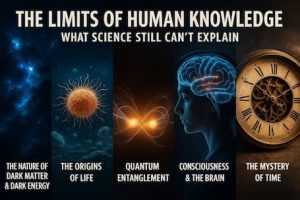
Why Does Science Still Have Mysteries?
Science is often thought of as a collection of answers, but in reality, it is a continuous process of asking better questions. Every major discovery opens the door to new scientific mysteries, revealing just how much remains unknown.
For example, astronomers have mapped billions of galaxies, yet they estimate that ordinary matter—the stars, planets, and gas we can observe—makes up only about 5% of the universe. The rest appears to consist of dark matter and dark energy, two mysterious components that scientists still cannot directly observe.
Likewise, neuroscientists have learned a great deal about the human brain, yet no one fully understands how consciousness emerges or why we dream. Even on Earth, researchers continue discovering new species, unexplored ecosystems, and geological processes that challenge existing theories.
The greatest scientific mysteries remind us that science is not about knowing everything. Instead, it is about continually testing ideas, questioning assumptions, and expanding humanity’s understanding of the natural world.
Universe & Space Scientific Mysteries
The universe is unimaginably vast, and despite decades of exploration, many of its biggest secrets remain hidden. These scientific mysteries have challenged astronomers and physicists for generations.
1. What Is Dark Matter?
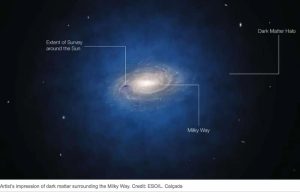
One of the greatest scientific mysteries is dark matter.
Astronomers know it exists because galaxies rotate far faster than visible matter alone can explain. Without an invisible source of gravity, many galaxies would simply fly apart.
Yet despite decades of research, no one has directly detected dark matter.
Leading theories suggest it may consist of entirely new types of particles that interact only weakly with ordinary matter.
What Scientists Know
- Dark matter makes up roughly 27% of the universe.
- It cannot be seen because it neither emits nor reflects light.
- Its existence is inferred from gravitational effects.
Why It’s Still a Mystery
Scientists have built highly sensitive detectors deep underground and conducted experiments using powerful particle accelerators, but none have conclusively identified dark matter.
Learn more about ongoing dark matter research from NASA.
2. What Is Dark Energy?
If dark matter is mysterious, dark energy may be even more puzzling.
Dark energy appears responsible for the accelerating expansion of the universe. Rather than slowing over time because of gravity, the universe is expanding faster and faster.
What Scientists Know
- Dark energy may account for about 68% of the universe.
- It influences the expansion of space itself.
Why It’s Still a Mystery
Researchers do not know what dark energy actually is or why it exists.
Some physicists believe it may be a property of space, while others think it points toward entirely new physics.
3. What Happened Before the Big Bang?
The Big Bang theory successfully explains much of the universe’s evolution after its earliest moments.
However, it does not answer one fundamental question:
What came before the Big Bang?
Some theories propose a previous universe.
Others suggest time itself began with the Big Bang, making the question impossible to answer in conventional terms.
At present, no scientific consensus exists.
4. Are We Alone in the Universe?
This question has fascinated humanity for centuries.
Astronomers have discovered thousands of planets orbiting distant stars, and many appear capable of supporting liquid water under the right conditions.
Yet despite decades of searching, scientists have found no confirmed evidence of extraterrestrial life.
NASA continues searching for signs of life through its astrobiology programs.
Possible Explanations
- Intelligent civilizations are extremely rare.
- Life is common but difficult to detect.
- Technological civilizations destroy themselves.
- We have not looked long enough.
This question remains among the greatest scientific mysteries of all time.
5. Why Is the Universe So Finely Tuned?
Many physical constants appear precisely balanced.
Even tiny changes could prevent stars, galaxies, or life from existing.
Scientists continue debating whether this remarkable balance reflects chance, deeper physical laws, or something entirely different.
6. What Happens Inside a Black Hole?
Einstein’s equations predict a singularity—a point of seemingly infinite density.
However, modern physics breaks down under such extreme conditions.
Scientists cannot yet describe what truly happens beyond a black hole’s event horizon.
7. What Is the True Nature of Time?
We measure time every day, but physicists still debate what time actually is.
Is time fundamental?
Or does it emerge from deeper physical processes?
Quantum physics and general relativity offer different perspectives, making time one of science’s deepest mysteries.
8. Why Does Gravity Resist Unification?
Scientists have successfully unified three of nature’s fundamental forces.
Gravity remains the exception.
Finding a theory that combines gravity with quantum mechanics is considered one of modern physics’ greatest challenges.
9. What Are Fast Radio Bursts?
Fast Radio Bursts (FRBs) are incredibly powerful flashes of radio waves arriving from distant galaxies.
Some last only milliseconds.
Although astronomers have identified likely sources for certain FRBs, many remain unexplained.
10. What Is the Great Attractor?
Our Milky Way Galaxy—and thousands of neighboring galaxies—appear to be moving toward an enormous gravitational region called the Great Attractor.
Because dense clouds of stars and dust obscure much of this region, scientists still do not fully understand what lies there.
11. Why Does Matter Exist at All?
The Big Bang should have created equal amounts of matter and antimatter.
If that had happened, they would have destroyed each other completely.
Instead, matter slightly outnumbered antimatter, allowing galaxies, stars, planets, and life to exist.
Scientists still don’t know why.
12. What Is the Shape of the Entire Universe?
The observable universe appears nearly flat.
But what about the universe beyond what we can observe?
It could be infinite, curved, or possess a geometry unlike anything we currently imagine.
13. What Is Planet Nine?
Some astronomers suspect an undiscovered giant planet lurks far beyond Neptune.
Its gravity could explain unusual orbital patterns among distant icy objects.
Despite years of searching, Planet Nine has never been confirmed.
14. Could White Holes Exist?
White holes are theoretical opposites of black holes.
Instead of pulling matter inward, they would eject matter outward.
No observational evidence has confirmed their existence.
15. Why Do Some Galaxies Stop Forming Stars?
Some galaxies continue producing stars for billions of years.
Others suddenly stop.
Astronomers continue investigating what shuts down star formation.
16. What Caused the Wow! Signal?
In 1977, astronomers detected an unusually strong radio signal from space.
It lasted only 72 seconds.
Despite numerous investigations, it has never been conclusively explained or repeated.
17. What Powers Ultra-High-Energy Cosmic Rays?
Some particles strike Earth’s atmosphere carrying energies millions of times greater than anything produced by human-made particle accelerators.
Scientists still debate where these extraordinary particles originate.
18. How Did the First Galaxies Form So Quickly?
The James Webb Space Telescope has revealed surprisingly massive galaxies that existed much earlier than many theories predicted.
Researchers are now revisiting models of galaxy formation.
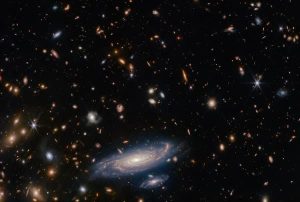
19. Why Do Supermassive Black Holes Grow So Fast?
Some black holes reached billions of solar masses within the universe’s first billion years.
Scientists still struggle to explain how they accumulated so much mass so quickly.
20. Will the Universe End?
Perhaps the greatest scientific mystery of all concerns the universe’s ultimate fate.
Possible endings include:
- Heat Death
- Big Rip
- Big Crunch
- Vacuum Decay
At present, no one knows which—if any—will occur.
🌌 Did You Know?
The observable universe contains hundreds of billions to possibly trillions of galaxies, yet scientists estimate that everything we can directly observe represents only a small fraction of the entire cosmos. The biggest scientific mysteries may still lie far beyond the reach of today’s most powerful telescopes.
Quick Recap
So far, you’ve discovered that:
- Dark matter and dark energy together appear to make up about 95% of the universe.
- Scientists still don’t know what happened before the Big Bang.
- The search for extraterrestrial life continues.
- Black holes, time, gravity, and matter remain among physics’ greatest unanswered questions.
- Mysterious phenomena such as the Wow! Signals, Fast Radio Bursts, and the Great Attractor continue to challenge astronomers.
- Even with cutting-edge observatories, many of the universe’s deepest scientific mysteries remain unsolved.
Earth & Ocean Scientific Mysteries (#21–40)
Although Earth is the only planet known to support life, scientists still have countless unanswered questions about our own world. From the planet’s deep interior to the darkest parts of the oceans, these scientific mysteries show that some of the greatest discoveries may still lie beneath our feet.
Earth Scientific Mysteries
21. What Is Earth’s Core Really Like?
Scientists know Earth’s core is made primarily of iron and nickel, but no human has ever come close to reaching it.
The deepest hole ever drilled—the Kola Superdeep Borehole—reached only about 12 kilometers (7.5 miles), barely scratching Earth’s crust.
What Scientists Know
- The inner core is believed to be solid.
- The outer core is liquid.
- The movement of molten metals generates Earth’s magnetic field.
Why It’s Still a Mystery
The immense heat and pressure make direct exploration impossible with current technology, so scientists rely on seismic waves to study Earth’s interior.
22. Why Does Earth’s Magnetic Field Reverse?
Earth’s magnetic poles have flipped many times throughout history.
These reversals happen irregularly, sometimes hundreds of thousands of years apart.
What Scientists Know
The magnetic field is generated by the flow of molten iron in the outer core.
Why It’s Still a Mystery
Researchers still cannot accurately predict when the next reversal will occur or fully explain why the process begins.
23. How Did Earth Get Its Water?
Liquid water makes Earth unique among known planets, but its origin remains one of the greatest scientific mysteries.
Leading Theories
- Water arrived on icy comets.
- Water came from water-rich asteroids.
- Some water formed naturally as Earth developed.
Scientists believe the answer may involve a combination of these processes.
24. Why Is Earth the Only Known Planet With Life?
Earth appears perfectly suited for life, but researchers still don’t know whether our planet is exceptionally rare—or whether similar worlds are common throughout the universe.
The discovery of life elsewhere would transform biology forever.
25. What Causes Ball Lightning?
Ball lightning is described as a glowing sphere that sometimes appears during thunderstorms.
Witnesses report it floating through the air, changing direction, and occasionally passing through windows.
Although scientists have reproduced similar effects in laboratories, their exact cause remains uncertain.
26. Why Do Some Earthquakes Occur Without Warning?
Despite major advances in geology, scientists cannot reliably predict exactly when and where most earthquakes will strike.
Researchers continue studying fault lines, rock stress, and subtle changes beneath Earth’s surface in hopes of improving future forecasting.
27. What Triggers Supervolcanoes?
Unlike ordinary volcanoes, supervolcanoes are capable of eruptions that can affect the global climate.
Scientists know where several supervolcanoes are located, including Yellowstone, but the precise conditions that trigger these massive eruptions remain uncertain.
28. Why Do Sinkholes Form So Suddenly?
Some sinkholes appear with little warning, swallowing roads, buildings, and even entire neighborhoods.
Scientists understand many of the geological processes involved, yet accurately predicting sudden collapses remains difficult.
29. Why Do Some Rocks “Move” on Their Own?
In places such as California’s Racetrack Playa, large rocks have been observed leaving long trails across dry lakebeds.
Researchers now know that thin sheets of ice, wind, and water can move many of them, but similar events reported elsewhere continue to be investigated.
30. Could Another Mass Extinction Be Underway?
Earth has experienced five major mass extinctions.
Some scientists argue that habitat loss, climate change, pollution, and biodiversity decline may indicate the beginning of a sixth mass extinction.
How this will unfold remains one of today’s most important scientific mysteries.
Ocean Scientific Mysteries
Although oceans cover about 71% of Earth’s surface, vast regions remain unexplored.
Many researchers argue that we know more about the surface of Mars than the deepest parts of our own oceans.
31. Why Have We Explored So Little of the Deep Ocean?

Extreme pressure, darkness, and cold make deep-sea exploration incredibly challenging.
Large portions of the ocean floor have never been directly observed.
NOAA continues mapping and exploring Earth’s oceans.
Every expedition continues to discover new species and ecosystems.
32. What Unknown Creatures Live in the Deep Sea?
Scientists discover hundreds of new marine species every year.
Many experts believe thousands—or even millions—of species remain undiscovered.
The deepest parts of the ocean may still hold life unlike anything we have seen.
33. What Causes Rogue Waves?
Rogue waves are enormous walls of water that appear unexpectedly in the open ocean.
Some exceed 25 meters (80 feet) in height.
Although researchers understand several contributing factors, predicting exactly when rogue waves will form remains difficult.
34. What Lies Beneath Antarctica’s Hidden Lakes?
More than 400 subglacial lakes have been identified beneath Antarctica’s thick ice.
Some have remained isolated for millions of years.
Scientists hope these hidden environments may reveal new forms of microbial life and clues about ancient climates.
35. Why Does the Bermuda Triangle Fascinate So Many People?
The Bermuda Triangle has become famous because of stories involving disappearing ships and aircraft.
What Scientists Know
Extensive investigations have found no credible evidence that the area is more dangerous than other heavily traveled parts of the ocean.
Why It Remains Popular
Legends, media coverage, and fictional accounts have helped keep the mystery alive despite the lack of scientific evidence for anything supernatural.
36. How Do Whales Navigate Across Oceans?
Many whale species migrate thousands of kilometers with remarkable accuracy.
Scientists believe they may use a combination of Earth’s magnetic field, the Sun, the stars, underwater landmarks, and sound, but the complete navigation process is still being studied.
37. What Creates the Ocean’s “Blue Holes”?
Blue holes are giant underwater sinkholes found in coastal regions.
Some extend hundreds of meters deep.
Researchers continue exploring these formations to understand how they developed and what unusual ecosystems they contain.
38. Could Unknown Ecosystems Exist in the Deepest Trenches?
The Mariana Trench reaches depths of nearly 11 kilometers (7 miles).
Despite multiple expeditions, scientists have explored only a tiny fraction of its environment.
New organisms continue to be discovered there.
39. How Do Hydrothermal Vent Communities Survive Without Sunlight?
Deep-sea organisms living around hydrothermal vents rely on chemicals rather than sunlight for energy.
This process, known as chemosynthesis, challenges long-held ideas about where life can exist.
Scientists continue studying these ecosystems because they may resemble environments where life first evolved.
40. Could Life Exist Beneath Earth’s Crust?
Researchers have found microbes living kilometers below Earth’s surface.
These organisms survive under conditions once thought impossible.
Their existence raises fascinating questions about the limits of life—and whether similar life might exist beneath the surfaces of Mars or icy moons like Europa.
🌍 Did You Know?
Scientists estimate that more than 80% of the world’s oceans remain unmapped, unobserved, or unexplored in detail. Some of the greatest scientific mysteries may be hidden in the deep sea rather than in outer space.
Earth Mysteries: Myth vs. Fact
| Myth | Fact |
|---|---|
| Scientists know everything about Earth. | Earth still contains many scientific mysteries, especially deep underground and beneath the oceans. |
| The Bermuda Triangle has supernatural powers. | There is no convincing scientific evidence that it is uniquely dangerous. |
| Ball lightning is purely imaginary. | Many credible observations exist, but scientists are still studying how it forms. |
| Earth’s magnetic field never changes. | Geological evidence shows that Earth’s magnetic poles have reversed many times. |
| The deep ocean has been fully explored. | Most of the deep ocean remains poorly explored compared with Earth’s surface. |
Quick Recap
So far, you’ve learned that:
- Earth’s interior remains beyond our direct reach.
- Scientists still debate the origin of Earth’s water.
- Earthquakes and supervolcanoes cannot yet be predicted with precision.
- Much of the deep ocean remains unexplored.
- New marine species continue to be discovered every year.
- Hydrothermal vent ecosystems have changed our understanding of where life can survive.
- Some of the most fascinating scientific mysteries may lie beneath Earth’s oceans and crust.
Want to discover more about our incredible planet and the universe beyond it? Read our 100 Incredible Space Facts That Will Change the Way You See the Universe and 50 Amazing Facts About the Human Brain to continue exploring science’s biggest wonders.
Human Body, Brain & Biology Scientific Mysteries (#41–70)
Of all the scientific mysteries explored so far, perhaps none are more personal than those involving our own bodies and minds. Despite centuries of medical advances, scientists are still trying to answer some of biology’s biggest questions.
How does consciousness arise? Why do we dream? What truly causes aging? How did life begin?
The answers could transform medicine, psychology, neuroscience, and even our understanding of what it means to be human.
Human Brain Scientific Mysteries
41. What Is Consciousness?

Consciousness—the awareness of ourselves and our surroundings—is one of the greatest scientific mysteries ever studied.
Scientists know that different regions of the brain contribute to perception, memory, and decision-making, but no one fully understands how billions of neurons working together produce subjective experience.
Leading Theories
- Global Workspace Theory
- Integrated Information Theory
- Predictive Processing
- Higher-Order Thought Theory
Despite decades of research, no single explanation has been universally accepted.
42. Why Do We Dream?
Everyone dreams, yet scientists still debate why.
Dreams may help process emotions, strengthen memories, rehearse future situations, or simply result from random brain activity during sleep.
Dreams may serve several functions rather than just one.
43. Why Do We Sleep?
Humans spend about one-third of their lives sleeping.
Sleep is essential for memory, learning, immune function, emotional regulation, and physical repair, yet researchers still cannot fully explain why every complex animal requires it.
44. How Does Memory Really Work?
Scientists understand many of the brain structures involved in memory, including the hippocampus, but the exact process by which experiences become long-term memories remains one of neuroscience’s biggest scientific mysteries.
Researchers are also studying why some memories remain vivid for decades while others disappear quickly.
45. Why Do We Forget?
Forgetting may seem like a flaw, but it is actually essential for healthy brain function.
Scientists believe forgetting helps remove unnecessary information, yet they still do not fully understand how the brain decides what to keep and what to erase.
46. Does Free Will Truly Exist?
Do humans consciously make decisions, or are our choices determined before we become aware of them?
Experiments have sparked intense debate among neuroscientists and philosophers, making free will one of the oldest and most controversial scientific mysteries.
47. Why Are Humans So Intelligent?
Compared with other animals, humans possess extraordinary abilities in language, planning, creativity, and abstract thinking.
Researchers continue investigating how evolution produced such advanced cognitive abilities.
48. Why Do Humans Laugh?
Laughter strengthens social bonds and communicates emotion.
Yet scientists still debate its original evolutionary purpose.
Was it developed for communication, survival, stress reduction, or all of these?
49. Why Do We Experience Déjà Vu?
Déjà vu is the strange feeling that you’ve experienced a situation before.
Researchers believe it may involve temporary mismatches in memory processing, but the phenomenon is not yet fully understood.
50. Why Do Placebos Work?
Some patients improve after receiving treatments that contain no active medicine.
This remarkable placebo effect demonstrates the powerful relationship between the brain and the body.
Scientists continue studying exactly how expectations influence healing.
Human Body Scientific Mysteries
51. Why Do We Age?
Every living organism ages, but no one fully understands why.
Several theories include:
- DNA damage
- Cellular wear and tear
- Telomere shortening
- Oxidative stress
- Evolutionary trade-offs
Researchers hope that understanding aging may lead to healthier, longer lives.
52. Why Can Some Animals Regenerate Lost Body Parts?
Salamanders can regrow limbs.
Some starfish regenerate entire arms.
Humans possess only limited regenerative abilities.
Scientists hope these discoveries may one day improve regenerative medicine.
53. Why Do Some People Live Beyond 100 Years?
Centenarians often share certain lifestyle and genetic characteristics.
However, scientists still cannot fully explain why some individuals remain healthy for exceptionally long lives.
54. Why Does the Immune System Sometimes Attack the Body?
Autoimmune diseases occur when the immune system mistakenly attacks healthy tissues.
Researchers continue investigating why immune tolerance sometimes fails.
55. What Causes Allergies?
Millions of people experience allergic reactions to harmless substances such as pollen or peanuts.
Scientists understand much of the immune response but still cannot explain why some people develop allergies while others do not.
56. Why Do Humans Yawn?
Yawning occurs across many animal species.
Theories include:
- Cooling the brain
- Increasing alertness
- Social communication
None completely explains every aspect of yawning.
57. Why Do We Hiccup?
Hiccups result from involuntary contractions of the diaphragm.
Scientists have proposed several evolutionary explanations, but none have been conclusively proven.
58. Why Do We Blush?
Humans are among the few animals that visibly blush.
The exact evolutionary purpose of blushing remains uncertain.
Some researchers believe it promotes trust by signaling honesty or embarrassment.
59. Why Do Fingerprints Form?
Fingerprints improve grip and sensitivity, yet scientists still debate the precise biological mechanisms that create each person’s unique pattern before birth.
60. Why Does the Human Body Heal Itself?
Cuts, broken bones, and damaged tissues often repair themselves remarkably well.
Researchers continue studying how to enhance these natural healing processes.
Biology Scientific Mysteries
61. How Did Life Begin?

Perhaps no question is more profound.
Scientists have proposed several hypotheses, including:
- Primordial soup
- Hydrothermal vent theory
- RNA World hypothesis
Despite decades of research, no single explanation has been confirmed.
62. Could Life Exist Without Water?
All known life depends on water.
However, scientists continue exploring whether alternative forms of life could exist using different solvents, such as liquid methane on Saturn’s moon Titan.
63. Why Did Complex Life Suddenly Expand?
Around 541 million years ago, Earth experienced the Cambrian Explosion, during which many major animal groups appeared relatively quickly in geological terms.
Researchers still debate what triggered this remarkable event.
64. Why Did Dinosaurs Dominate for So Long?
Dinosaurs ruled Earth for more than 160 million years.
Scientists continue studying the evolutionary advantages that made them so successful.
65. Why Did Some Dinosaurs Survive as Birds?
Modern birds evolved from certain groups of dinosaurs.
Researchers continue uncovering how feathers, flight, and other adaptations enabled their survival after the mass extinction.
66. Why Is DNA So Effective at Storing Information?
DNA contains the instructions needed to build and maintain every living organism.
Scientists still marvel at how such an elegant molecular system evolved.
67. How Many Species Exist on Earth?
Scientists have identified around 2 million species, but estimates suggest that millions more remain undiscovered, especially among insects, fungi, and marine life.
68. Why Do Some Organisms Glow?
Bioluminescence occurs in jellyfish, deep-sea fish, fungi, insects, and many other organisms.
Scientists understand much of the chemistry but continue studying why bioluminescence evolved independently so many times.
69. Could There Be Unknown Microorganisms Everywhere?
Microbes thrive in boiling springs, deep underground, Antarctic ice, and acidic lakes.
Researchers believe countless microbial species remain undiscovered.
70. Could Evolution Be Happening Faster Than We Think?
Evolution is often viewed as slow, but scientists have observed rapid evolutionary changes in bacteria, insects, fish, and other organisms over relatively short periods.
Understanding these processes remains one of biology’s most important scientific mysteries.
🧠 Did You Know?
The human brain contains approximately 86 billion neurons, yet scientists still cannot fully explain how these cells produce thoughts, emotions, memories, imagination, and consciousness. This makes the brain one of the greatest frontiers in modern science.
Biology & Brain Mysteries: Myth vs. Fact
| Myth | Fact |
|---|---|
| Scientists fully understand the human brain. | Many aspects of consciousness, memory, and intelligence remain scientific mysteries. |
| We use only 10% of our brains. | Brain imaging shows that virtually all parts of the brain have functions, even if not active simultaneously. |
| Dreams are meaningless. | Researchers have proposed several evidence-based theories, but there is no single accepted explanation. |
| Evolution has stopped in humans. | Human populations continue to evolve through genetic and environmental pressures. |
| DNA contains all the answers about life. | DNA explains much, but many questions about gene regulation, development, and the origin of life remain unanswered. |
Quick Recap
So far, you’ve learned that:
- Consciousness remains one of the greatest scientific mysteries.
- Scientists still debate why humans dream, sleep, laugh, yawn, and blush.
- Aging, memory, and the placebo effect are not yet fully understood.
- The origin of life remains unsolved.
- Millions of species may still be undiscovered.
- Evolution continues to reveal new surprises.
Want to learn more about the incredible human mind? Explore our detailed guides on 50 Amazing Facts About the Human Brain, 100 Psychology Facts About Human Behavior, and 100 Incredible Space Facts That Will Change the Way You See the Universe to discover even more of science’s greatest wonders.
Ancient Civilization & History Scientific Mysteries (#71–100)
While modern science has solved countless historical puzzles, many ancient discoveries still challenge researchers. Archaeologists continue uncovering new evidence, yet some of history’s greatest scientific mysteries remain unanswered.
Ancient Civilization Scientific Mysteries
71. How Were the Egyptian Pyramids Built?

The Great Pyramid of Giza has stood for over 4,500 years.
Scientists know the Egyptians used remarkable engineering techniques, but researchers continue debating exactly how millions of massive stone blocks were transported and positioned with such precision.
Modern evidence favors large workforces, ramps, sledges, and ingenious engineering rather than supernatural explanations.
72. Who Built Göbekli Tepe?
Discovered in modern-day Türkiye, Göbekli Tepe dates back roughly 11,000 years.
It was built before agriculture became widespread, challenging long-held assumptions about how civilization developed.
Scientists continue asking:
Did organized religion help create civilization—or did civilization create organized religion?
73. Why Were the Nazca Lines Created?
Massive geometric shapes and animal figures stretch across Peru’s Nazca Desert.
Leading theories suggest they served ceremonial, astronomical, or cultural purposes.
No single explanation has been universally accepted.
74. What Happened to the Indus Valley Civilization?
One of the world’s earliest urban civilizations disappeared around 1900 BCE.
Researchers have proposed climate change, shifting rivers, economic decline, and migration, but no single explanation fully accounts for its decline.
75. Why Was Stonehenge Built?
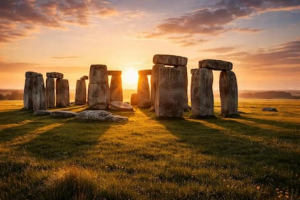
Stonehenge remains one of Europe’s greatest archaeological mysteries.
Possible purposes include:
- Astronomical observatory
- Religious monument
- Burial site
- Ceremonial gathering place
Evidence supports several possibilities, but certainty remains elusive.
76. What Is the Antikythera Mechanism?
Recovered from an ancient shipwreck, this remarkable device functioned like an early mechanical computer.
Scientists continue studying how ancient engineers achieved such astonishing precision more than 2,000 years ago.
77. What Caused the Bronze Age Collapse?
Around 1200 BCE, several powerful civilizations declined within a relatively short period.
Researchers suspect a combination of drought, warfare, migration, and economic disruption rather than a single cause.
78. Where Is the Tomb of Cleopatra?
Despite centuries of searching, archaeologists have not conclusively identified the burial place of Cleopatra VII and Mark Antony.
New excavations continue in Egypt.
79. Why Did the Maya Abandon Their Great Cities?
The Maya civilization did not vanish, but many major cities were abandoned.
Scientists point to prolonged drought, warfare, political instability, and environmental pressures working together.
80. What Lies Hidden Beneath the Amazon Rainforest?
Modern laser mapping (LiDAR) has revealed previously unknown cities, roads, and settlements beneath dense vegetation.
Researchers believe many more ancient sites remain undiscovered.
Unexplained Scientific Mysteries
81. Why Is Mathematics So Effective?
Physicists have long wondered why mathematics describes nature with extraordinary accuracy.
Some call this “the unreasonable effectiveness of mathematics.”
No one knows exactly why the universe follows mathematical patterns so closely.
82. Why Do Physical Constants Have Their Values?
The speed of light, the gravitational constant, and other fundamental values appear finely balanced.
Even tiny differences might prevent stars, planets, or life from existing.
Scientists still seek a deeper explanation.
83. Is Our Universe the Only One?
Some theories in cosmology suggest our universe could be one of many.
The multiverse hypothesis remains speculative because it has not been directly tested.
84. Why Does Quantum Mechanics Work So Well?
Quantum mechanics is one of the most successful scientific theories ever developed.
Yet even its founders disagreed about what it truly means.
Scientists continue debating the interpretation of quantum reality.
85. Can Quantum Gravity Be Discovered?
General relativity explains gravity on large scales.
Quantum mechanics explains extremely small scales.
Combining them into one unified theory remains one of physics’ greatest scientific mysteries.
86. What Happens at Absolute Zero?
Absolute zero represents the lowest possible temperature.
Scientists can approach it closely but cannot reach it exactly.
Matter behaves in extraordinary ways near this limit.
87. Could Unknown Laws of Physics Exist?
History shows that every generation uncovers discoveries.
Many physicists believe future observations may reveal entirely new physical principles.
88. What Is Information?
Information plays a central role in computing, genetics, quantum physics, and black hole research.
Scientists continue debating whether information is simply a mathematical concept—or a fundamental property of reality itself.
89. Why Does the Universe Follow Physical Laws?
Perhaps the deepest philosophical scientific mystery is why consistent laws exist at all.
Science describes how nature behaves remarkably well.
Why those laws exist remains unknown.
90. Will Science Ever Explain Everything?
Many researchers believe science will continue solving mysteries indefinitely.
Others argue that some questions may always remain beyond human understanding.
Only time will tell.
Future Scientific Mysteries
91. Could Humans Discover Alien Life This Century?
Upcoming missions to Mars, Europa, Enceladus, Titan, and distant exoplanets may answer one of humanity’s oldest questions.
No confirmed evidence exists today—but the search continues.
92. Will We Build Cities on Mars?
Space agencies and private companies are developing technologies that could make long-term human settlement possible.
Whether permanent colonies become a reality remains uncertain.
93. Can Aging Be Dramatically Slowed?
Scientists are making remarkable advances in longevity research.
However, extending healthy lifespan significantly remains an active area of investigation.
94. Could We Cure Every Genetic Disease?
Gene-editing technologies hold enormous promise.
Researchers continue studying how to make these treatments safer, more precise, and widely available.
95. Will Artificial Intelligence Solve Scientific Mysteries?
AI is helping researchers analyze enormous datasets, discover new materials, and accelerate medical research.
Even so, human creativity, experimentation, and critical thinking remain essential to scientific discovery.
96. Will We Ever Understand Consciousness Completely?
New brain imaging techniques continue to improve our knowledge of the mind.
Whether consciousness can ever be fully explained remains uncertain.
97. Could We Find Another Earth?
Astronomers continue discovering Earth-sized planets in habitable zones.
One day, scientists may identify a world remarkably similar to our own.
98. Will We Discover New Forms of Life?
Life on Earth continually surprises researchers.
Entirely new branches of life may still await discovery in extreme environments.
99. What Mystery Will Change Science Forever?
History shows that unexpected discoveries often transform our understanding of reality.
The next revolutionary breakthrough could come from astronomy, medicine, biology, physics—or a field that doesn’t yet exist.
100. What Question Should Humanity Ask Next?
Perhaps the greatest scientific mystery is not the one we’ve already identified—but the one we haven’t yet imagined.
Every answer creates new questions, ensuring that scientific exploration never truly ends.
🔬 Science Myths vs. Facts
| Myth | Fact |
|---|---|
| Scientists have explained almost everything. | Every major discovery creates new scientific mysteries to investigate. |
| Ancient civilizations had supernatural technology. | Archaeological evidence points to remarkable human ingenuity and engineering rather than supernatural forces. |
| If a mystery remains unsolved, it can never be explained. | Many mysteries once thought impossible have been solved through advances in science and technology. |
| Science and curiosity are opposites. | Curiosity is the foundation of scientific progress. |
| Not knowing the answer means science has failed. | Unanswered questions are what drive new discoveries and innovations. |
Frequently Asked Questions (FAQs)
1. What are scientific mysteries?
Scientific mysteries are questions about the natural world that remain unanswered despite extensive research.
2. What is the biggest scientific mystery?
Many scientists consider dark matter, consciousness, the origin of life, and dark energy among the greatest scientific mysteries.
3. Has science solved every mystery?
No. Every scientific breakthrough reveals new questions to investigate.
4. What percentage of the universe is still unknown?
Scientists estimate that ordinary matter makes up only about 5% of the universe, while dark matter and dark energy account for the remaining 95%.
5. Why is consciousness so difficult to explain?
Although researchers understand many brain functions, they still do not know how subjective awareness emerges from neural activity.
6. Are there still undiscovered species on Earth?
Yes. Scientists estimate that millions of species may remain unidentified, especially in oceans, rainforests, and underground ecosystems.
7. Could alien life exist?
There is currently no confirmed evidence of extraterrestrial life, but many scientists consider it possible given the vast number of planets in the universe.
8. Why do scientific mysteries matter?
They inspire new research, drive technological innovation, and deepen our understanding of the universe and ourselves.
Final Thoughts

The history of science is a story of curiosity, persistence, and discovery. Every generation has answered questions that once seemed impossible, only to uncover even greater scientific mysteries waiting beyond the horizon.
From the invisible nature of dark matter to the origins of consciousness, from the unexplored depths of Earth’s oceans to the rise and fall of ancient civilizations, these mysteries remind us that knowledge is always evolving.
Rather than seeing unanswered questions as failures, we should view them as opportunities. Today’s mysteries are the starting points for tomorrow’s breakthroughs, and the next revolutionary discovery could come from a student, an explorer, or a scientist inspired by the same questions you have just read about.
The universe still has countless secrets to reveal—and that is what makes science one of humanity’s greatest adventures.
Science advances through careful observation, experimentation, and collaboration. Organizations around the world, such as the American Association for the Advancement of Science (AAAS), continue to explore these mysteries every day.

Leah Awuor is a seasoned content creator and digital storyteller with a passion for crafting narratives that inform, inspire, and engage. With a wealth of experience profiling media personalities, politicians, celebrities, and emerging trends, Leah brings together sharp analytical insight and a natural talent for storytelling.
Her work is recognized for its accuracy, depth, and ability to spark meaningful conversations. As the creative force behind some of Fact-Pedia’s most-read articles, Leah consistently delivers high-impact content that resonates with diverse audiences across the globe.
Driven by curiosity and a commitment to editorial excellence, she covers everything from breaking news to in-depth celebrity profiles and cultural commentary. Leah’s ability to anticipate trends and deliver compelling stories makes her a trusted and influential voice in the digital media landscape.